Anthropic Shipped Opus 5 at the Old Opus Price. It Beats Fable 5 on Most Rows for Half the Money.
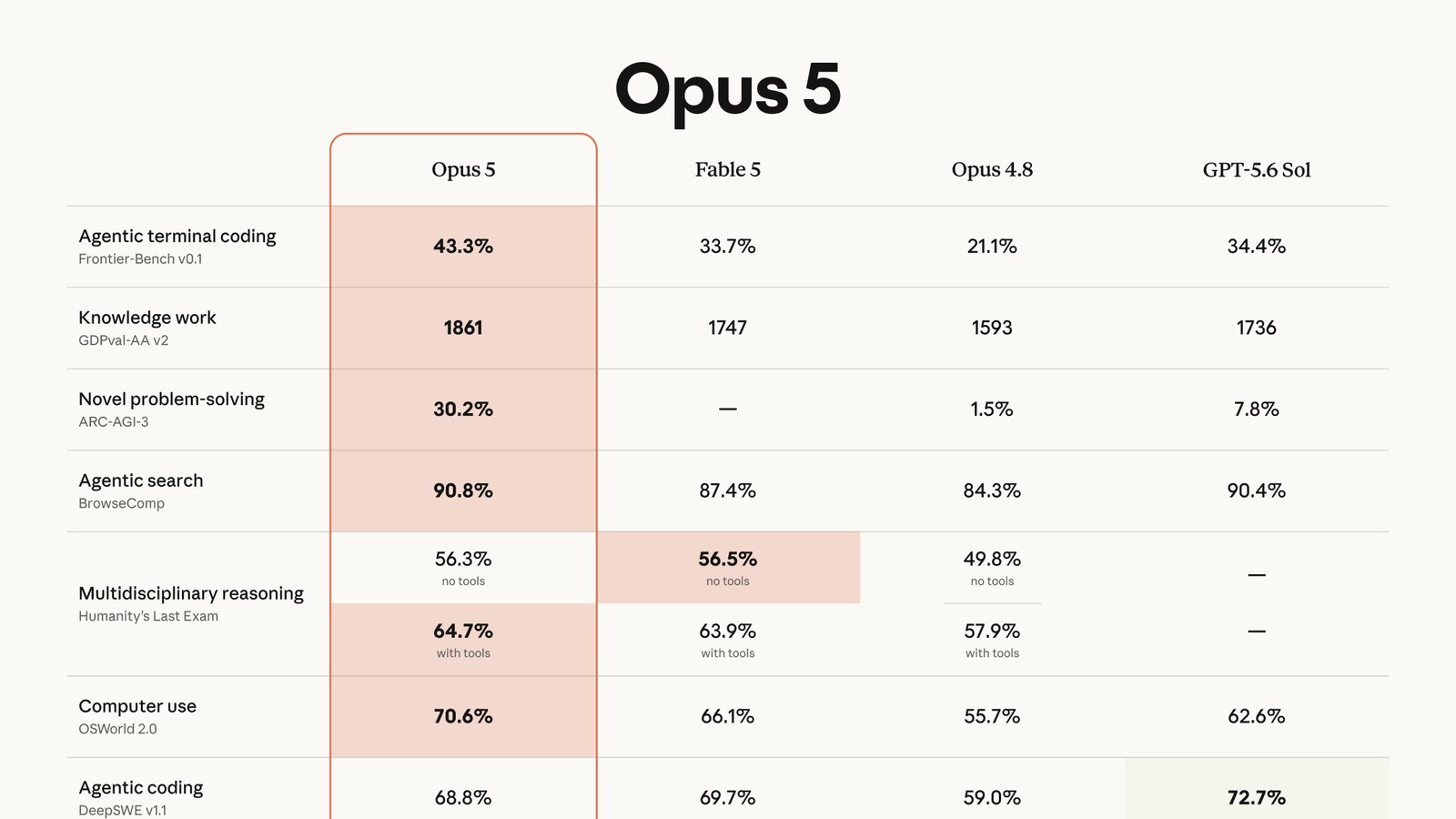
Anthropic released Claude Opus 5 today. The API id is claude-opus-5, it carries a 1 million token context window, and it costs $5 per million input tokens and $25 per million output.
That last number is the story, and it is worth stating plainly because the default assumption about a new Opus tier is wrong here. Opus 5 does not cost more than Opus 4.8. It costs exactly the same. Every benchmark gain in this release is free in dollar terms, which is not how the last several frontier launches went. GPT-5.5 doubled OpenAI's price when it landed in April. Fable 5 arrived in June at $10 and $50, double the Opus rate. Opus 5 holds the line.
It also lands at exactly half of Fable 5. And on Anthropic's own launch table, it beats Fable 5 on most of the rows they chose to publish.
What actually changed against Opus 4.8
The generational comparison is lopsided in a way that benchmark tables usually are not. These are Anthropic's numbers, not independent runs, so treat them as vendor-reported until someone reproduces them. With that caveat in place:
| Benchmark | Opus 4.8 | Opus 5 | Change |
|---|---|---|---|
| ARC-AGI-3 (novel problem-solving) | 1.5% | 30.2% | 20x |
| Frontier-Bench v0.1 (agentic terminal coding) | 21.1% | 43.3% | 2.1x |
| OSWorld 2.0 (computer use) | 55.7% | 70.6% | +14.9 pts |
| AutomationBench (business workflows) | 17.0% | 26.0% | +9.0 pts |
| DeepSWE v1.1 (agentic coding) | 59.0% | 68.8% | +9.8 pts |
| GDPval-AA v2 (knowledge work) | 1593 | 1861 | +268 ELO |
| BrowseComp (agentic search) | 84.3% | 90.8% | +6.5 pts |
The ARC-AGI-3 row is the one to sit with. Opus 4.8 scored 1.5 percent, which is noise. Opus 5 scores 30.2. That is not an increment on an existing capability, it is a capability the previous model did not have. ARC-AGI is specifically designed to resist memorization, so a jump of that shape is either a real change in how the model generalizes or a contamination story, and only independent replication settles which.
The computer-use jump matters more commercially. Fifteen points on OSWorld 2.0 is the difference between a GUI agent that needs a human watching it and one that can be left alone for a task. If you shelved a computer-use pilot in the spring because the success rate did not clear your bar, this is the release that justifies re-running it, and it costs the same per token as the model that failed.
The awkward part: it outscores the model that costs twice as much
Anthropic still describes Fable 5 as its highest-capability tier. The launch table does not really support that at the row level.
Across the eleven rows where both Opus 5 and Fable 5 report a directly comparable number, Opus 5 posts the higher score on seven and Fable 5 on four. Two of Fable 5's four wins are inside two tenths of a point, which is not a difference anyone should make a purchasing decision on.
| Row | Opus 5 ($5/$25) | Fable 5 ($10/$50) | Takes it |
|---|---|---|---|
| AutomationBench | 26.0% | 17.4% | Opus 5, by 8.6 |
| Frontier-Bench v0.1 | 43.3% | 33.7% | Opus 5, by 9.6 |
| OSWorld 2.0 | 70.6% | 66.1% | Opus 5, by 4.5 |
| BrowseComp | 90.8% | 87.4% | Opus 5, by 3.4 |
| GDPval-AA v2 | 1861 | 1747 | Opus 5, by 114 |
| BioMysteryBench (hard) | 49.4% | 46.5% | Opus 5, by 2.9 |
| Humanity's Last Exam (tools) | 64.7% | 63.9% | Opus 5, by 0.8 |
| Legal Agent Benchmark | 11.7% | 13.3% | Fable 5, by 1.6 |
| DeepSWE v1.1 | 68.8% | 69.7% | Fable 5, by 0.9 |
| Humanity's Last Exam (no tools) | 56.3% | 56.5% | Fable 5, by 0.2 |
| FrontierCode v1.1 (Main) | 53.4% | 53.5% | Fable 5, by 0.1 |
Two more rows appear on the chart and are not in that table, because they are not comparable. On HealthBench Professional and the human-solved split of BioMysteryBench, the Fable column reports a Mythos 5 number rather than a Fable 5 one. Mythos 5 is the safeguards-lifted variant available only through Project Glasswing, so those ceilings are not something a normal customer can buy. We excluded them here for the same reason we excluded them from the Fable 5 rows in our benchmark data back in June.
So what is Fable 5 for now? On this evidence, a narrow set: legal agent work, and coding pipelines where a sub-point edge on DeepSWE or FrontierCode is worth paying double. That is a real but thin argument. Anthropic's tier language and Anthropic's own published numbers are pulling in different directions, and customers will notice, because the finance team reads the price sheet even when the engineering team reads the tier chart.
Three API changes, two of which break working code
The upgrade is free. The port is not. Three defaults changed against Opus 4.8, and only one of them is purely good news.
Thinking is now on by default. On Opus 4.8, omitting the thinking parameter meant no thinking. On Opus 5 the same request runs adaptive thinking. This is a silent cost and truncation change, not just a behavior one, because max_tokens caps thinking plus response text together. A route that never set thinking and sized max_tokens tightly around its answer can now truncate mid-response. Nothing errors. You just get worse output and a larger bill.
Disabling thinking is capped at high effort. Passing thinking: disabled alongside xhigh or max effort returns a 400. Opus 4.8 accepted that combination, so any latency-sensitive route built on it fails outright rather than degrading. The check runs per request, so a call that raises effort later in a conversation is rejected even though earlier calls succeeded.
The prompt cache minimum halved. Opus 5 caches prompts from 512 tokens, down from 1024 on Opus 4.8. This is the free one: prompts that were previously too short to cache now create entries with no code change at all. Worth re-checking anything you wrote off as uncacheable.
Two smaller operational notes. Opus 5 draws on its own rate-limit pool rather than the shared Opus 4.x bucket, so shifting traffic across neither frees headroom on the old pool nor inherits it, and capacity planning needs redoing. And Priority Tier does not cover Opus 5 at all, which is a genuine regression for anyone who bought Priority capacity against 4.8.
Where it runs
Claude API, Amazon Bedrock, Google Cloud, and Microsoft Foundry at launch. Bedrock uses the prefixed id anthropic.claude-opus-5. Fast mode is available on the Claude API only, priced at $10 and $50, which is to say fast mode on Opus 5 costs what Fable 5 costs at standard speed.
Opus 5 also carries elevated cybersecurity safeguards, which means classifiers can decline a request and return a successful response with a refusal stop reason rather than an error. Code that reads the first content block without checking the stop reason will break on those. Anthropic shipped a server-side fallback option in the same release that reruns a declined request on another model automatically, and cyber-category refusals route to Opus 4.8. If you are building anything adjacent to security tooling, wire that up on day one rather than after the first incident.
What we are watching
Whether the ARC-AGI-3 number survives contact. A jump from 1.5 to 30.2 on a benchmark built to resist memorization is the single most consequential claim in this release. Independent replication settles it, and nothing else will.
Whether Fable 5 gets repriced. A top tier that costs double and loses seven of eleven published rows is not a stable position. Either Fable 5 comes down, or Anthropic publishes the evaluations where its lead is real.
Whether SWE-bench shows up. Anthropic's table leans on Frontier-Bench, DeepSWE, and FrontierCode, and does not include a SWE-bench Verified number for Opus 5. Fable 5 launched with one. The omission may be nothing, but SWE-bench is the number most teams still benchmark against, and its absence from a coding- focused launch table is conspicuous.
For the live pricing and spec comparison, see Claude Opus 5, or the head-to-head breakdowns against Opus 4.8 and Fable 5.